
AI Didn't Write This Article
What Actually Happens When I Write With Artificial Intelligence

By J. H. Irwin
Author | Content Creator | Technology Strategist
Recently, Substack introduced AI detection to help readers understand when artificial intelligence has been used in the creation of an article. I welcome that kind of transparency. Readers deserve to know when AI has played a role, and authors should never pretend a machine had no involvement if it did.
At the same time, I believe those labels have an important limitation.
They cannot see the process.
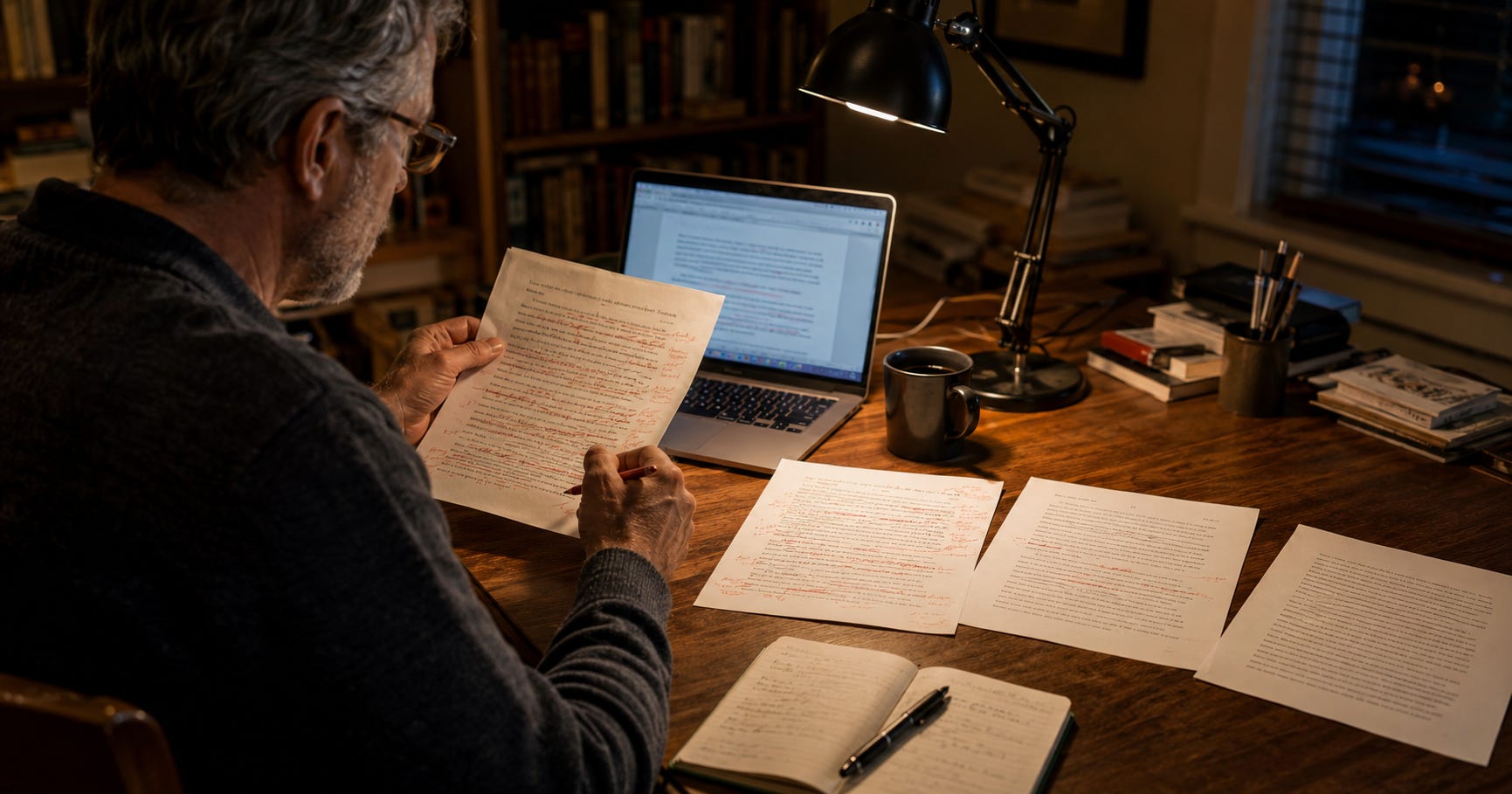
If a label simply says an article was created with AI, it tells you nothing about how it was created. It cannot distinguish between someone who typed a single prompt, copied the response, and clicked Publish, and someone who spent hours shaping, questioning, revising, and rewriting every idea until it reflected their own voice.
Those are two very different things.
My recent article, Where Empathy Is Born, is a perfect example.
The finished piece reads like a single, cohesive essay, but it wasn’t written that way. Nor did I ask AI to “write an article about empathy.” In fact, the article existed long before AI ever entered the conversation.
It began with something AI could never invent: my life.
For months I had been writing my memoir before I ever asked for help. Four chapters already existed, filled with memories of growing up on the shores of Lake Erie, discovering I was different long before I understood why, living in a house that was never finished, navigating a complicated relationship with my parents, and eventually realizing those experiences had quietly shaped the empathy readers often tell me they find in my writing.
The facts were mine. The memories were mine. The emotions were mine. The insights were mine. What I wanted was help transforming a portion of that memoir into a standalone article that readers could connect with, while remaining unmistakably my own voice.
That’s when the conversation began.
The first draft wasn’t what I wanted.
Rather than accepting it, I challenged it.
I pointed out that it focused too much on my childhood instead of exploring the larger question of where empathy comes from. That one observation changed the entire structure of the article. Suddenly it wasn’t just my story. It became an invitation for readers to reflect on their own lives.
Then we kept working.
I didn’t like certain wording, so we rewrote it.
I felt a section about discovering my baby book lacked emotional depth, so we rewrote that too.
A paragraph about my father didn’t accurately capture the complexity of the man I knew, so I challenged it until it did.
I realized the ending focused too heavily on pain when I wanted readers to leave with hope, resilience, and courage. So we rewrote the conclusion.
Then I asked for better titles.
Then better subtitles.
Then a stronger opening.
Then an image concept that reflected the article’s emotional heart instead of simply illustrating childhood.
Then a social media post.
At one point I even stopped the process to say, “Reduce the number of one-line paragraphs.” That wasn’t AI making a stylistic choice. It was me editing an editor.
This continued for dozens of exchanges.
Every revision moved the article a little closer to what I wanted to say, not what AI wanted to say.
That process has a name.
It’s called looping.
Instead of treating AI like a vending machine that dispenses finished articles, I treat it like an editorial partner. We move back and forth through ideas, language, structure, pacing, tone, and emotion until the writing sounds unmistakably like me, my voice. Sometimes that takes twenty exchanges. Sometimes it takes a hundred. The finished article isn’t the product of a single prompt. It’s the result of hundreds of creative decisions, and every meaningful one belongs to me.
In many ways, it isn’t all that different from working with a human editor.
An editor doesn’t live your life. They don’t create your memories. They don’t know what your father was like or how it felt to grow up questioning who you were. They simply help you express those experiences more clearly. They point out repetition, challenge weak passages, ask difficult questions, and suggest stronger wording.
No one walks away believing the editor wrote the book.
The same is true here.
Artificial intelligence never walked the beaches of Lake Erie alone. It never wondered why it felt different from the other boys. It never lived through the AIDS crisis, built a thirty-year relationship with my husband, or sat beside my parents trying to understand them as they grew older. Those experiences belong to me alone. They are the raw material from which every article I write is built.
AI helps me polish the stone.
It did not create the quarry.
In fact, I would argue that AI has made me a better writer, not because it writes for me, but because it refuses to let me settle for my first draft. It forces me to think more carefully about what I actually mean. It offers alternatives I reject as often as I accept them. It catches repetition, questions assumptions, and helps organize ideas that have been circling inside my mind for years.
Most importantly, it lets me spend more time refining ideas instead of wrestling with sentences.
That’s a very different role from replacing an author.
If you’ve followed my work for any length of time, you’ve probably noticed recurring themes: humanity, empathy, resilience, hope, democracy, LGBTQ+ life, aging, grief, and the extraordinary complexity of being human. Those themes existed long before AI. They come from sixty-five years of living, loving, losing, questioning, observing, and writing.
Artificial intelligence didn’t create that voice.
It simply helps me hear it more clearly.
So if a future article of mine carries an AI label, I hope readers won’t assume a machine wrote it. Instead, I hope they’ll imagine what actually happened: a long conversation filled with questions, revisions, disagreements, discoveries, and countless small decisions. The technology supplied possibilities, but the judgment, the memories, the experiences, and the voice remained entirely my own.
When you read my work, you are not reading the story of artificial intelligence.
You are reading the story of a human being who has found a remarkable new way to tell it.
Technology is changing the world. Read about it → The Augmented Life