

Your AI Trainer: J. H. Irwin
Author | Content Creator | Technology Strategist
For more than thirty years, I have built my career around technology
I have been a software developer, software engineer, data analyst, reporting specialist, architect, and technology leader. During that time, I have witnessed wave after wave of innovation arrive with predictions that entire professions would disappear. Personal computers were supposed to eliminate jobs. The internet was supposed to eliminate jobs. Cloud computing was supposed to eliminate jobs. Automation was supposed to eliminate jobs. Each technological revolution changed the nature of work, but none of them eliminated the need for capable people who were willing to learn, adapt, and evolve.
Today, artificial intelligence has become the latest source of anxiety for millions of workers, and unlike many previous technological advances, the concerns are understandable. AI can already write code, generate reports, analyze data, summarize documents, create presentations, answer questions, and automate tasks that once required significant human effort. It is easy to look at these capabilities and wonder whether the careers many of us spent decades building are slowly being replaced by machines.
I understand that concern because I work in one of the very professions frequently listed as being at risk. Every week there seems to be another article declaring that software engineers, analysts, developers, writers, accountants, and countless other professionals are about to become obsolete. The headlines are designed to generate clicks, but they often overlook an important reality. While artificial intelligence is certainly changing how work gets done, it is also creating entirely new opportunities for those willing to embrace it.
The mistake many people make is viewing AI as a replacement for human expertise. In reality, AI is proving to be far more effective as an amplifier of expertise. The technology can generate solutions, but it still requires someone who understands the problem. It can produce code, but it does not truly understand the business requirements behind that code. It can create reports, but it does not know which questions matter most to decision-makers. It can analyze data, but it cannot determine whether the conclusions it reaches make sense within the broader context of an organization, industry, or society.
That distinction matters because it reveals where the future opportunities exist.
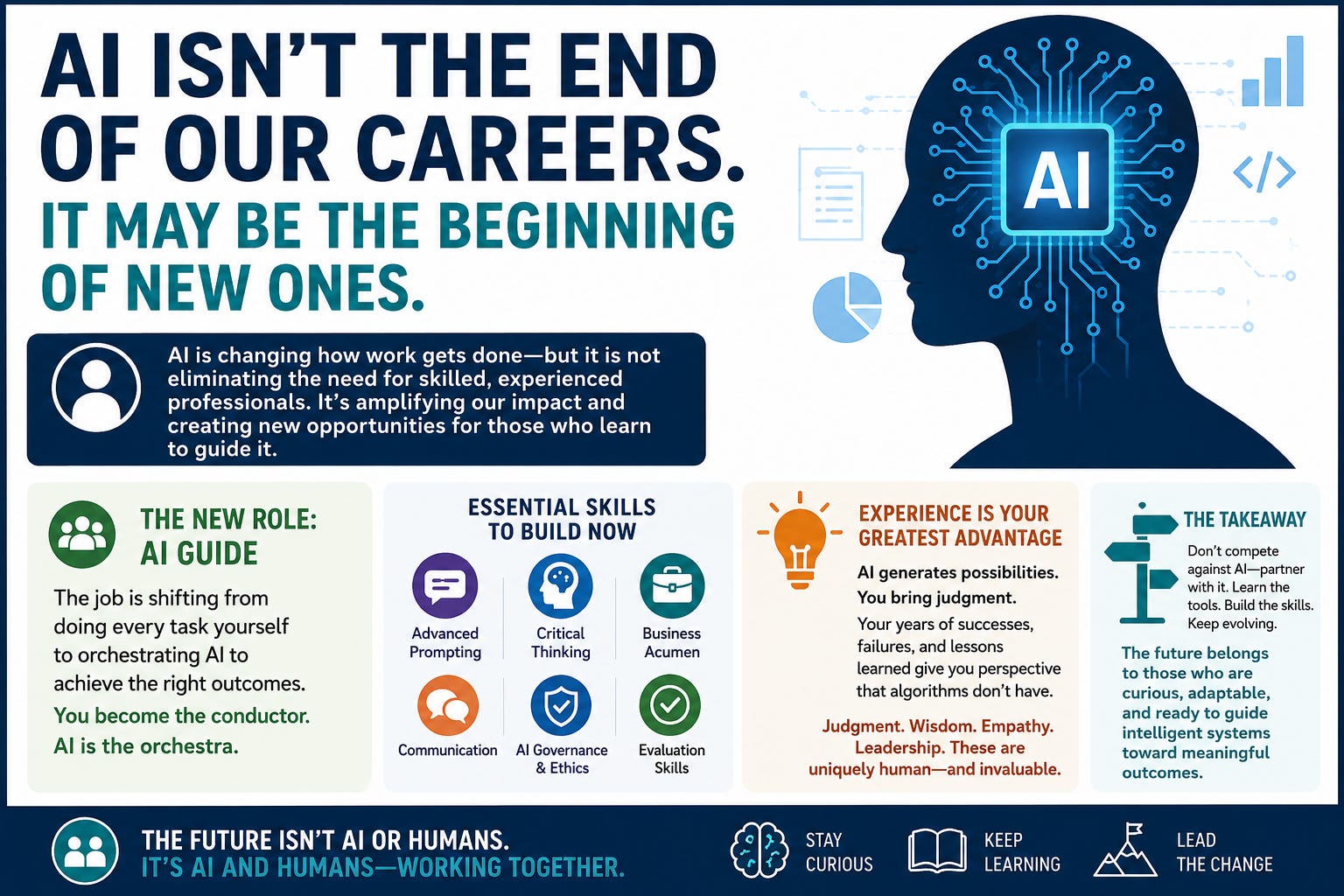
For decades, technical professionals were valued largely for their ability to create. We wrote the code. We built the reports. We designed the databases. We constructed the workflows. Those skills remain important, but increasingly our value may come from our ability to guide intelligent systems toward the right outcomes rather than manually performing every step ourselves. In many ways, the profession is shifting from builder to conductor. The orchestra has become far more capable, but it still requires someone who understands the music.
One of the most important skills professionals can begin developing today is advanced prompting. Many people hear the phrase “prompt engineering” and immediately assume it is a highly technical discipline reserved for AI researchers. In reality, advanced prompting is simply the art of communicating clearly with artificial intelligence. It involves understanding how to define objectives, provide context, establish constraints, identify desired outcomes, and iteratively refine results until they meet expectations.
The individuals who become exceptionally skilled at guiding AI systems are likely to be among the most valuable professionals in the next decade. Organizations will need people who understand not only how AI works, but how to direct it toward solving real business problems. A well-crafted prompt can often mean the difference between a mediocre result and an exceptional one. Just as previous generations learned programming languages to communicate with computers, today’s professionals are learning how to communicate effectively with artificial intelligence.
Beyond prompting, there are several other skills that will become increasingly valuable. Critical thinking will remain essential because AI-generated content is not always correct. Someone must validate assumptions, identify errors, recognize gaps, and ensure that outputs align with reality. Business knowledge will become even more important because AI can assist with execution, but understanding organizational objectives, customer needs, and industry dynamics remains fundamentally human. Communication skills will also grow in importance because translating complex business challenges into clear instructions for both people and AI systems requires clarity, precision, and insight.
Another area of opportunity lies in AI governance, ethics, and oversight. As organizations deploy artificial intelligence at scale, they will need professionals who understand responsible use, privacy concerns, compliance requirements, security implications, and risk management. These are not areas where experience becomes less valuable. If anything, they become more important as technology becomes more powerful.
Perhaps the most encouraging aspect of this transition is that experienced professionals may be uniquely positioned to succeed. One of the great misconceptions surrounding AI is that decades of experience suddenly become irrelevant. My own observations suggest the opposite. Artificial intelligence is remarkably effective at generating possibilities, but experienced professionals possess something that cannot easily be replicated by an algorithm. They have judgment.
Judgment is what allows an experienced software engineer to recognize a design flaw before it becomes a production issue. It is what enables a seasoned analyst to identify when data appears technically correct but logically impossible. It is what allows an experienced leader to understand the human consequences of a business decision. Judgment is developed through years of successes, failures, lessons learned, and hard-earned wisdom. AI can assist with many tasks, but it does not possess lived experience.
As I look toward the future, I do not see a world where artificial intelligence eliminates the need for human talent. I see a world where human talent evolves. The professionals who thrive will not be those who refuse to learn AI, nor will they be those who blindly trust everything it produces. The greatest opportunities will belong to those who learn how to partner with these new tools while continuing to apply their uniquely human strengths.
For anyone worried about their career, my advice is simple. Do not spend your energy competing against artificial intelligence. Spend your energy learning how to work alongside it. Explore AI tools. Learn advanced prompting techniques. Understand how these systems think, where they excel, and where they fail. Develop your critical thinking, communication, and leadership abilities. Most importantly, continue learning.
Every major technological shift creates disruption, uncertainty, and fear. It also creates opportunity. The people who recognize that opportunity early are often the ones who shape the future rather than becoming victims of it.
Artificial intelligence is changing our professions. There is little doubt about that. What remains to be seen is how each of us chooses to respond. For those willing to adapt, learn, and grow, the future may hold far more opportunity than many of today’s headlines would have us believe.
Technology is changing the world. Read about it → The Augmented Life