

By J. H. Irwin
Author | Content Creator | Technology Strategist
The Questions For Our Time
For most of human history, technology has existed outside of us.
We picked up tools. We built machines. We carried computers in our pockets and strapped smart devices to our wrists. Even the most advanced technologies remained separate from the human body.
Now, for the first time, that distinction is beginning to disappear.
What happens when technology moves from something we use to something we become connected to? What happens when a computer is no longer on a desk, in a pocket, or resting on a face, but implanted directly into the brain itself?
Those questions are no longer science fiction. They are being explored today by one of the most ambitious and controversial technological projects in the world: Neuralink.
What Is Neuralink?
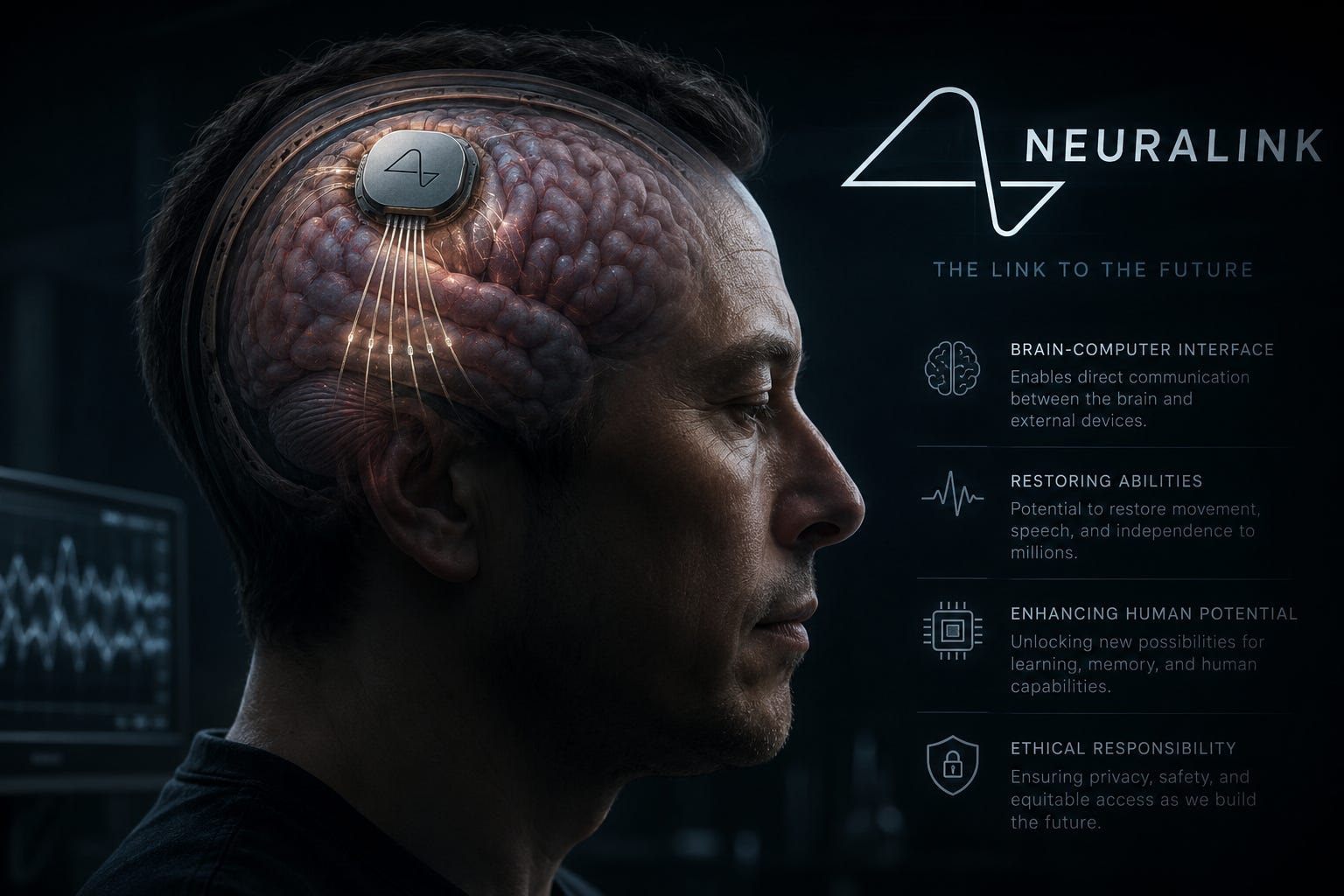
Founded in 2016 by Elon Musk and a team of neuroscientists and engineers, Neuralink is developing what is known as a brain-computer interface, often abbreviated as a BCI. The goal is deceptively simple to describe but extraordinarily difficult to achieve.
Neuralink seeks to create a direct communication pathway between the human brain and computers.
The company’s flagship device, known as the N1 Implant, is a small wireless computer implanted into the skull. Ultra-thin electrode threads, thinner than human hair, are inserted into specific regions of the brain using a highly specialized surgical robot. These electrodes detect neural activity and translate brain signals into digital commands that can control external devices.
In practical terms, a person could move a computer cursor, type on a screen, operate software, or control physical devices simply by thinking about the intended action.
No keyboard.
No mouse.
No voice command.
Just thought.
Where Is Neuralink Today?
Despite headlines that sometimes make the technology sound futuristic and distant, Neuralink has already entered human clinical trials.
Its first human participant received an implant in January 2024 as part of the PRIME Study, a first-in-human clinical trial designed to evaluate the safety and functionality of the technology. The study focuses primarily on individuals with severe paralysis caused by spinal cord injuries or ALS.
The initial participant, Noland Arbaugh, demonstrated the ability to move a computer cursor, browse the internet, play video games, and interact with digital systems using only his thoughts.
Since then, the program has expanded significantly. As of early 2026, Neuralink reported more than twenty participants enrolled in trials across multiple countries, including the United States, Canada, the United Kingdom, and the United Arab Emirates.
Importantly, Neuralink devices remain investigational and are not yet approved for widespread commercial use. Clinical trials are still focused on proving safety, reliability, and long-term effectiveness.
The Immediate Promise
For people living with paralysis, the implications are profound.
Imagine being unable to move your arms, hands, or fingers but still being able to write an email, send a text message, operate a wheelchair, or communicate with loved ones through a computer.
For individuals with ALS, spinal cord injuries, traumatic brain injuries, or other neurological conditions, Neuralink represents the possibility of restoring lost independence.
Researchers also envision future applications that could help restore speech in patients who can no longer communicate verbally. Neuralink has already received regulatory recognition related to speech restoration technologies.
Other potential medical applications include:
Restoring movement after paralysis
Assisting people with severe motor disabilities
Treating certain neurological disorders
Restoring vision for some forms of blindness
Helping patients communicate after strokes
Creating more advanced prosthetic limb control
These are not merely technological achievements. They represent opportunities to restore dignity, independence, and quality of life to millions of people.
Beyond Medicine
The truly fascinating questions begin when we move beyond medical necessity.
Elon Musk has frequently discussed a future in which brain-computer interfaces become powerful enough to allow direct interaction with artificial intelligence, digital information, and perhaps even other humans. While many of these possibilities remain speculative, they are central to the long-term vision that has made Neuralink one of the most discussed technologies on Earth.
Imagine a future where:
Information is accessed instantly through thought
Language barriers disappear through neural translation
Prosthetic limbs outperform biological limbs
Memory enhancement becomes possible
Digital devices are controlled without physical interfaces
Artificial intelligence systems interact directly with the human brain
These ideas sound like scenes from science fiction films because, until recently, they belonged there.
Today, they are active areas of research.
The Ethical Questions We Cannot Ignore
Every transformative technology creates new opportunities and new risks.
The same was true of the internet, social media, genetic engineering, and artificial intelligence.
Neuralink is no different.
If brain-computer interfaces become widespread, society will confront questions unlike any we have faced before.
Who owns the data generated by your thoughts?
Can neural activity be hacked?
Could governments or corporations gain access to information that was once entirely private?
What happens when enhanced individuals possess capabilities unavailable to others?
Could economic inequality evolve into biological inequality?
The possibility of creating a world divided between enhanced and unenhanced humans is no longer purely theoretical. It is a scenario ethicists, scientists, and policymakers are already discussing.
There is also the philosophical question that may ultimately prove the most important.
At what point does human augmentation fundamentally alter what it means to be human?
The answer may not be obvious.
Eyeglasses augment vision. Pacemakers augment the heart. Cochlear implants augment hearing. Society readily accepts these technologies because they restore functions we consider normal.
But what happens when technology begins enhancing abilities beyond normal human limits?
The line between therapy and enhancement may become increasingly difficult to define.
The Road Ahead
Neuralink remains in its infancy. The company is still conducting clinical trials, gathering data, refining its technology, and working toward regulatory approval.
Many technical challenges remain.
Many ethical questions remain.
Many promises remain unproven.
Yet it is increasingly difficult to dismiss brain-computer interfaces as fantasy.
For the first time in history, humans are beginning to establish direct digital connections between biological brains and machines. Whether that future ultimately empowers humanity, divides humanity, or transforms humanity in ways we cannot yet imagine remains an open question.
What is certain is that we have crossed an important threshold.
The age of wearable technology is giving way to the age of implantable technology.
And as that transition unfolds, the boundary between human and machine may become one of the defining questions of the twenty-first century.
Closing Thoughts
Neuralink is not merely a story about technology.
It is a story about humanity itself.
For some, it represents hope, independence, restored abilities, and new possibilities for those living with devastating conditions.
For others, it raises legitimate concerns about privacy, inequality, autonomy, and the future relationship between people and machines.
Both perspectives deserve careful consideration.
Because the question is no longer whether human augmentation is coming.
The question is how far we are willing to go once it arrives.
Technology is changing the world. Read about it → The Augmented Life