



By J. H. Irwin
Author | Content Creator | Technology Strategist
The most significant advancement wasn’t a new chip or another successful patient. It was eliminating one of brain surgery’s most delicate steps.
When most people hear news about Neuralink, the headlines tend to focus on the dramatic. Someone controls a computer with their thoughts. A patient plays chess using only their brain. Another milestone is reached in human trials.
Those accomplishments deserve attention, but they can also overshadow the quieter engineering advances that make them possible.
This week, Neuralink announced what may ultimately prove to be one of its most significant achievements yet. It wasn’t a new implant, a faster processor, or an artificial intelligence breakthrough. Instead, it was something that sounds almost mundane: finding a way to implant its brain-computer interface without first cutting through the brain’s protective outer membrane.
It is the kind of accomplishment that rarely becomes a headline, yet it has the potential to change how brain-computer interfaces are implanted for years to come.
The Brain’s First Line of Defense
The human brain is protected by three layers of tissue collectively known as the meninges. The outermost of these layers, called the dura mater, is remarkably tough. Its name comes from the Latin phrase meaning “tough mother,” an appropriate description for a membrane whose primary purpose is to shield one of the body’s most fragile organs.
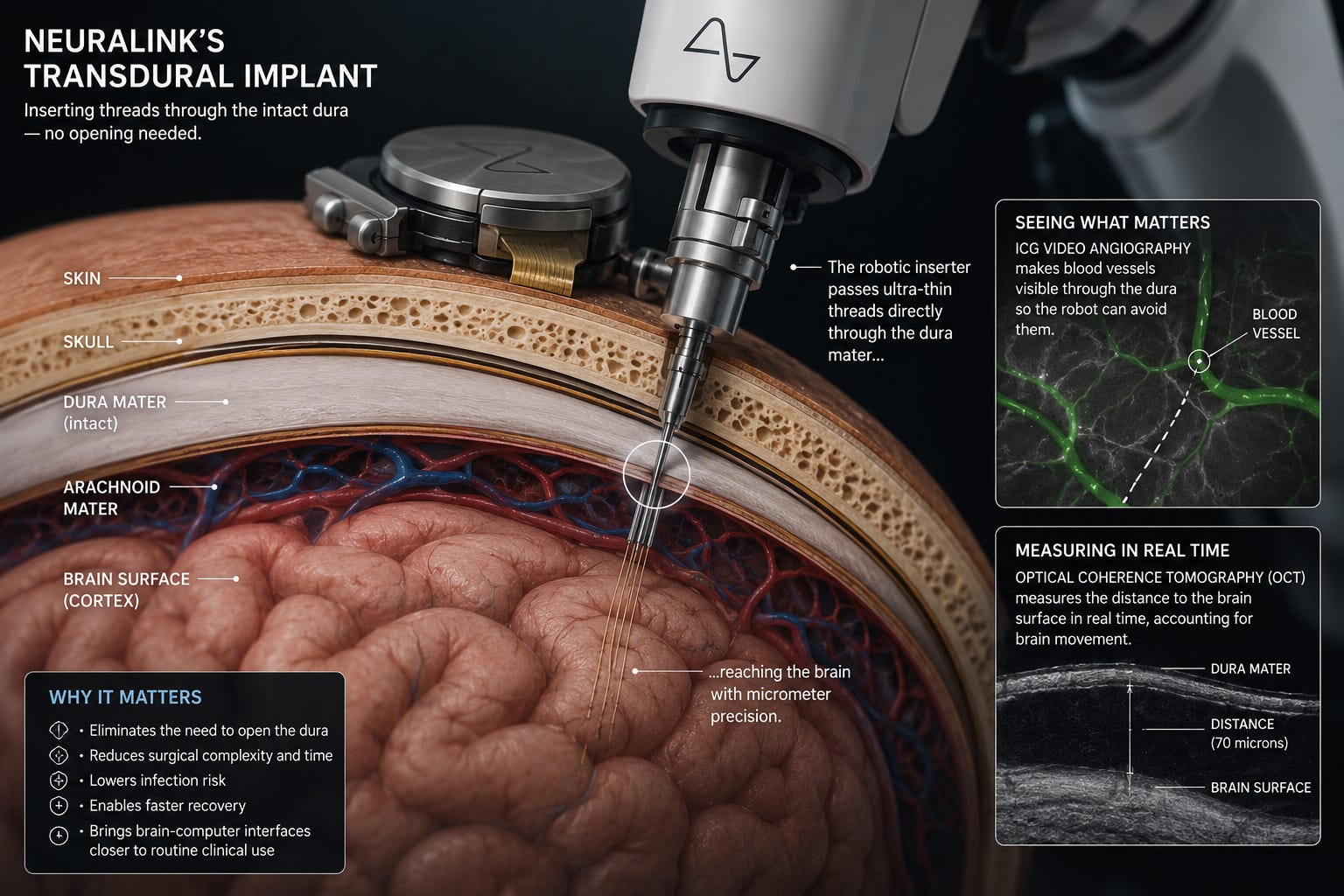
Until now, implanting a Neuralink device required surgeons to perform a procedure known as a durectomy, carefully opening or removing a small section of this protective layer before the robot could insert the implant’s microscopic electrode threads into the brain.
While this has been performed safely in clinical trials, it remains one of the most technically demanding portions of the surgery. Every additional surgical step introduces complexity, consumes valuable operating time, and carries its own degree of risk.
Engineers often say that the best design is not one with more parts, but one with fewer. The same principle applies to surgery.
One Less Cut
Neuralink has now demonstrated a new implantation technique that allows its surgical robot to insert the flexible electrode threads directly through the intact dura without first opening it.
At first glance, that may not sound revolutionary. In reality, it represents years of engineering and one of the most sophisticated robotic surgical achievements the company has accomplished.
The electrode threads themselves are thinner than a human hair. The dura, by comparison, is many times thicker and considerably stronger. Successfully passing those delicate threads through an intact protective membrane without damaging either the electrodes or the underlying brain tissue required solving several extraordinarily difficult problems simultaneously.
The company redesigned its insertion needle to generate enough force to penetrate the membrane while still maintaining microscopic precision. Engineers also developed advanced optical systems capable of visualizing blood vessels hidden beneath the dura so the robot can avoid them during implantation. Additional imaging technologies continuously measure the changing distance between the protective membrane and the brain itself, allowing the robotic system to adjust in real time with extraordinary accuracy.
None of these advances are particularly glamorous on their own. Together, however, they represent the difference between a highly specialized experimental procedure and one that begins moving closer to routine clinical practice.
Engineering Over Headlines
There is a tendency to judge technological progress by dramatic public demonstrations. We celebrate the moment someone controls a robotic arm with their thoughts or speaks through a synthesized voice after losing the ability to communicate.
Those moments are important because they reveal what is possible.
But lasting progress usually comes from quieter breakthroughs that receive far less attention.
The invention of the modern airplane was not defined by a single successful flight. It was improved through thousands of refinements that made flying safer, more reliable, and eventually commonplace.
The same pattern is emerging with brain-computer interfaces.
Each refinement to the implantation process reduces complexity. Each improvement makes the technology more repeatable. Each reduction in surgical risk moves it one step closer to broader clinical adoption.
Sometimes the greatest innovation is simply removing an unnecessary step.
A Glimpse of the Future
Neuralink’s long-term ambitions extend well beyond allowing someone to move a computer cursor. Researchers are pursuing technologies that could restore speech to individuals who can no longer communicate, provide control of robotic limbs, and eventually explore methods of restoring functional vision by stimulating the brain directly.
Every one of those future capabilities depends upon safely placing thousands of tiny electrodes into the brain.
Making that process simpler is not merely an engineering convenience. It is foundational to everything that comes next.
If brain-computer interfaces are ever to become widely available for treating neurological disease, spinal cord injury, paralysis, or sensory loss, implantation must become safer, faster, and more consistent than it is today.
This latest accomplishment moves the industry meaningfully in that direction.
Beyond Biology
One of the recurring themes of Beyond Biology is that transformative technologies rarely arrive all at once. Instead, they emerge through countless incremental improvements that gradually reshape what is possible.
This latest Neuralink milestone illustrates that perfectly.
The public may remember the videos of people controlling computers with their thoughts. History, however, may remember something far quieter: the moment engineers figured out how to leave the brain’s natural armor intact.
It is not the kind of breakthrough that captures imaginations overnight.
It is the kind that changes medicine forever.
As brain-computer interfaces continue to mature, the biggest advances may no longer come from what the implant allows us to do. They may come from making the technology so safe, so precise, and so reliable that one day it becomes as routine as many other neurosurgical procedures are today.
That future is still years away, but this week’s achievement suggests we may have taken a much larger step toward it than the headlines alone would have us believe.
Technology is changing the world. Read about it → The Augmented Life