


Your AI Trainer: J. H. Irwin
Author | Content Creator | Technology Strategist
When most people hear the words “artificial intelligence,” they picture something futuristic
They imagine humanoid robots walking through shopping malls, self-driving cars navigating city streets, or computers powerful enough to outthink humanity.
For many, AI feels like something designed for programmers, engineers, and technology companies. It sounds complicated, expensive, and far removed from everyday life.
That is exactly why so many people are missing one of the most useful tools ever placed within reach of ordinary individuals.
Take Susan, for example.
Susan is fifty-eight years old. She isn’t a programmer. She doesn’t work in technology. She has never written a line of code in her life. Most days are spent juggling work, household responsibilities, aging parents, doctor appointments, bills, grocery shopping, and trying to remember where she left her reading glasses.
Like many people, Susan often ends her day feeling exhausted, wondering where all the hours went.
One afternoon, her daughter suggested she try an AI assistant.
Susan rolled her eyes.
“I don’t need a robot,” she said.
What she didn’t realize was that AI wasn’t there to replace her. It was there to help her.
The first task seemed almost laughably simple.
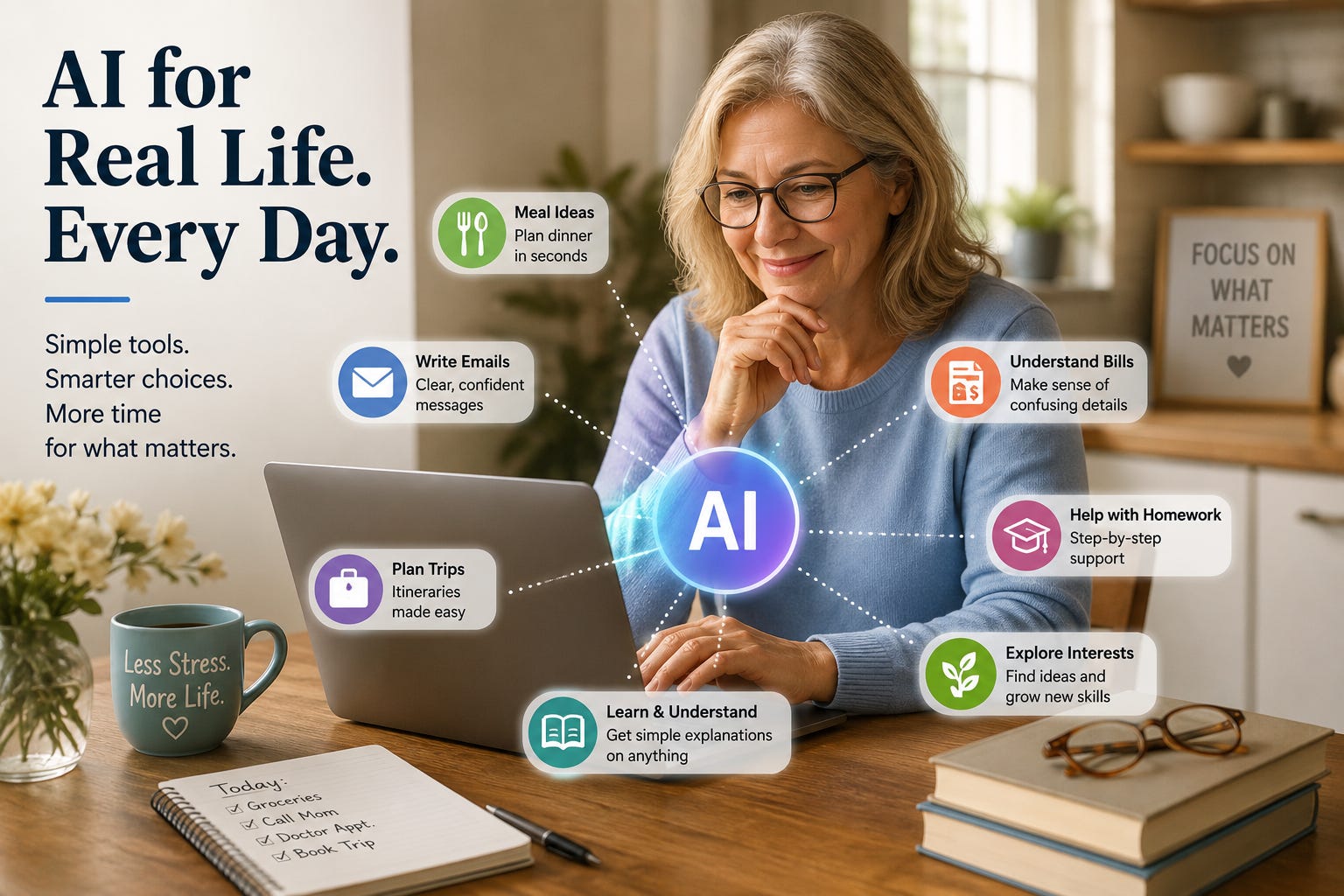
Susan had a refrigerator full of random ingredients: chicken breasts, broccoli, carrots, rice, and a half-used container of sour cream.
Normally she would search recipe websites, scroll through advertisements, and spend twenty minutes trying to decide what to make.
Instead, she typed a single sentence into an AI assistant:
“I have chicken, broccoli, carrots, rice, and sour cream. What can I make for dinner tonight?”
Within seconds, she had five meal ideas, complete recipes, preparation steps, and even suggestions for leftovers.
The meal turned out great.
More importantly, she had saved herself thirty minutes of frustration.
The next week, Susan used AI to write a difficult email.
Her aging father needed assistance from an insurance company, and she was struggling to explain the situation clearly.
Instead of staring at a blinking cursor, she told the AI what she wanted to say.
The assistant organized her thoughts into a professional, respectful message that she could review and personalize before sending.
What had taken an hour in the past took less than ten minutes.
Then came vacation planning.
Susan and her husband wanted to visit New England in the fall. Normally that meant hours spent comparing websites, reading reviews, and creating spreadsheets.
This time she asked AI to create a seven-day itinerary that included scenic drives, historic sites, seafood restaurants, and moderate walking distances.
Within moments, she had a detailed plan that would have taken an entire weekend to assemble on her own.
Little by little, AI became less of a technology and more of a helper.
When she needed to understand a confusing medical bill, she asked AI to explain the terminology in plain English.
When her grandson struggled with algebra homework, she asked AI to explain the problem step-by-step.
When she wanted to start a garden, AI helped identify plants suitable for Florida’s climate.
When she needed to compare Medicare options, AI helped organize information so she could better understand the choices available to her.
None of these tasks required technical knowledge.
None required programming.
None required a computer science degree.
What they required was curiosity.
The truth is that most people are already surrounded by tools designed to save time. We use calculators instead of slide rules. GPS instead of paper maps. Search engines instead of encyclopedia sets.
AI is simply the next evolution of that trend.
The difference is that AI doesn’t just provide information. It helps organize, summarize, explain, brainstorm, plan, and create.
Think of it as having an assistant available twenty-four hours a day.
Not an assistant who makes decisions for you.
Not an assistant who replaces your judgment.
An assistant who helps you think, learn, and accomplish tasks more efficiently.
Of course, AI is not perfect. It can make mistakes. It can misunderstand questions. It sometimes presents information confidently even when it is wrong.
That means people must continue to exercise common sense, verify important information, and use their own judgment.
The goal is not to surrender thinking to a machine.
The goal is to spend less time wrestling with routine tasks and more time focused on what matters most.
For Susan, that meant fewer hours spent searching, comparing, formatting, and organizing.
It meant more time with family.
More time reading.
More time enjoying life.
That is why average people should not be afraid of AI.
The greatest promise of artificial intelligence may not be found in laboratories, research centers, or billion-dollar technology companies.
It may be found in kitchens, living rooms, home offices, and retirement communities.
It may be found in helping ordinary people navigate an increasingly complicated world.
The future of AI is not only about creating smarter machines.
It is about helping people live smarter lives.
And for millions of non-technical individuals, that future has already arrived.
Technology is changing the world. Read about it → The Augmented Life