


By J. H. Irwin
Author | Content Creator | Technology Strategist
For most of human history, tools have waited patiently for instructions
A hammer does nothing until someone picks it up. A calculator sits idle until numbers are entered. Even computers, despite their extraordinary capabilities, have largely remained obedient servants waiting for human direction. We tell them what to do, they do it, and then they wait for the next command.
Artificial intelligence is beginning to change that relationship.
Much of the public conversation surrounding AI has focused on chatbots. We ask a question. The AI responds. We request an image. The AI creates one. We seek help writing an email. The AI drafts it. While impressive, these interactions still place humans firmly in control of every step. The AI remains a sophisticated tool waiting for instructions.
A new generation of artificial intelligence is emerging that operates very differently.
Technology companies are increasingly investing in what are known as AI agents, systems capable of performing multi-step tasks with far less human supervision. Instead of answering a question, these systems can pursue an objective. Rather than responding to each instruction individually, they can plan, execute, monitor progress, adapt to changing circumstances, and work toward a desired outcome.
That may sound like a subtle distinction, but it represents one of the most significant shifts in the history of computing.
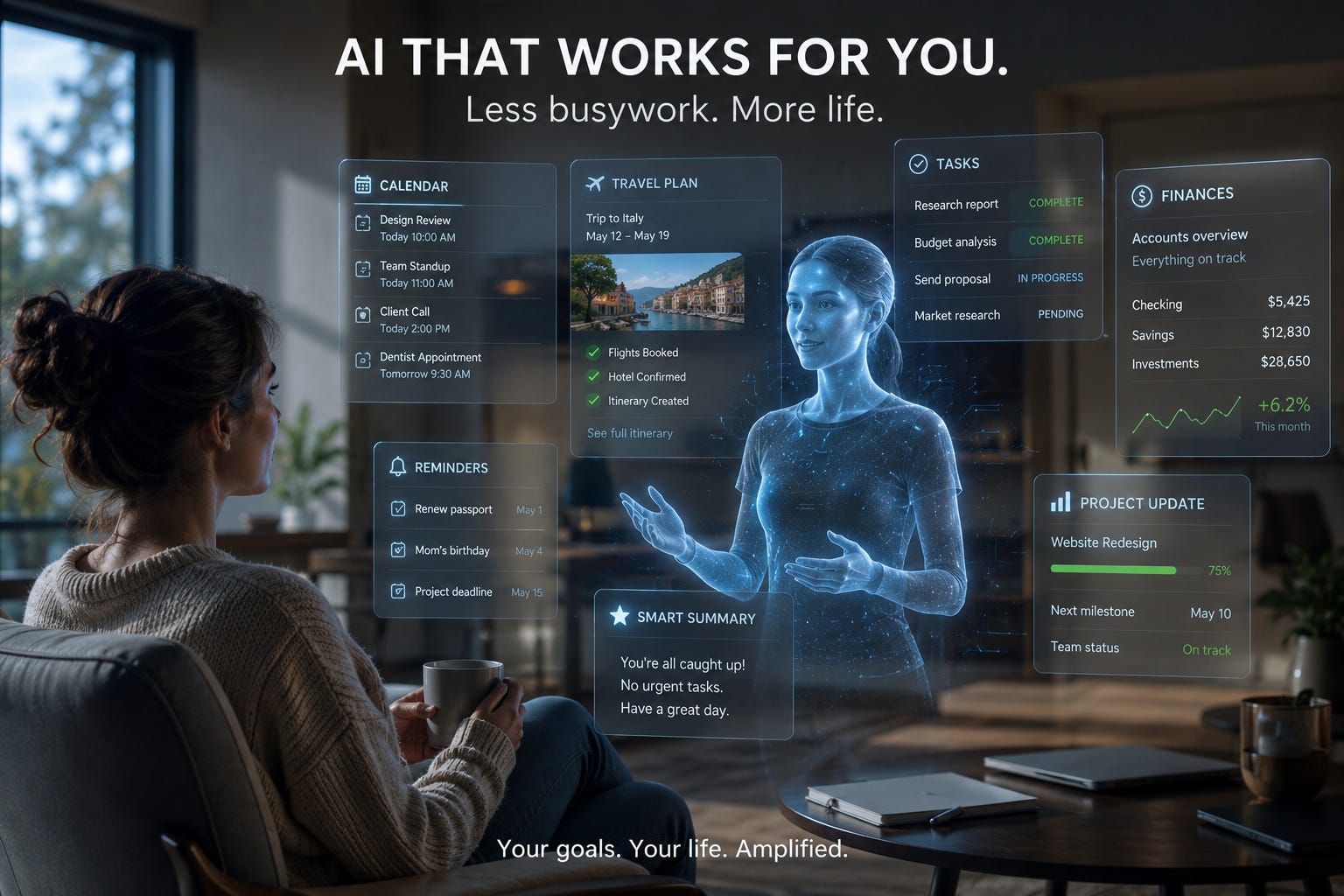
Imagine telling your AI assistant that you want to take a vacation to Italy next spring. Today’s AI can suggest destinations, recommend hotels, and answer questions. An agentic AI system could potentially research flights, compare hotel options, monitor prices, recommend an itinerary based on your preferences, make reservations, adjust plans if costs change, and present a complete travel package for your approval. Instead of helping you perform the work, it performs much of the work itself.
The same concept applies to countless aspects of daily life.
A future AI agent might manage household finances, monitor recurring bills, identify opportunities to save money, schedule maintenance appointments for your home, coordinate family calendars, track healthcare appointments, and remind you about important deadlines before they become problems.
For professionals, the implications may be even more dramatic. An AI agent could research competitors, analyze market trends, prepare reports, schedule meetings, summarize communications, track project progress, and identify potential risks without being explicitly directed at every step.
The result is a fundamental change in how humans interact with technology.
For decades, learning technology has meant learning software. We learned word processors, spreadsheets, databases, presentation tools, project management systems, and countless specialized applications. Entire careers have been built around mastering increasingly complex software environments.
The next generation may never experience technology that way.
Instead of learning software, people may simply learn how to communicate goals.
Rather than asking, “How do I use this application?” the question becomes, “What outcome do I want?”
That shift could be as transformative as the arrival of the internet itself.
History offers useful parallels. Before automobiles, moving goods and people required understanding horses, wagons, routes, and logistics. Cars simplified transportation while simultaneously creating entirely new industries and opportunities. The internet reduced barriers to accessing information while creating new professions that previously did not exist.
Agentic AI may follow a similar pattern
Some jobs will undoubtedly change. Certain administrative tasks that consume hours each day could increasingly be handled by intelligent systems. Routine research, scheduling, coordination, documentation, and reporting functions may become highly automated. Organizations will require fewer people performing repetitive tasks and more people focused on judgment, creativity, leadership, relationship-building, and strategic decision-making.
This transition will create understandable anxiety.
Every major technological revolution has generated fears about displacement. The industrial revolution transformed manufacturing. Automation reshaped factories. Computers changed office work. The internet disrupted media, retail, and communications.
Yet history also shows that humans tend to adapt by moving toward work that emphasizes uniquely human capabilities. Empathy, trust, ethics, creativity, emotional intelligence, and complex judgment remain extraordinarily difficult to automate. In many cases, technology does not eliminate human value so much as shift where that value is created.
The more immediate question may not be economic but philosophical.
As AI agents become increasingly capable, how much responsibility are we willing to delegate?
Most people are comfortable allowing software to recommend a movie. Fewer are comfortable allowing software to manage investments, make healthcare recommendations, or negotiate important decisions without oversight. Society will need to determine where the boundaries should exist between assistance and autonomy.
There are also legitimate concerns surrounding privacy, accountability, and control. An AI system capable of managing large portions of our lives would necessarily require access to significant amounts of personal information. Safeguards, transparency, and ethical standards will become increasingly important as these technologies mature.
At the same time, the potential benefits are difficult to ignore.
Millions of people feel overwhelmed by the growing complexity of modern life. Calendars are crowded. Information arrives continuously. Administrative responsibilities seem endless. Many individuals spend enormous amounts of time managing tasks rather than pursuing goals, relationships, creativity, or experiences that bring meaning to their lives.
Agentic AI offers the possibility of reducing some of that burden.
The promise is not that machines will replace human beings. The promise is that machines may increasingly handle the routine mechanics of life, allowing humans to devote more energy to the things that make us uniquely human.
Whether that promise is fulfilled responsibly remains to be seen.
What seems increasingly clear is that we are witnessing a transition from tools that respond to commands toward systems that pursue objectives. The distinction may appear small today. In hindsight, it may prove to be one of the defining technological shifts of the twenty-first century.
For decades, computers waited for instructions.
The next generation may begin asking what we want to accomplish and then getting to work.
Technology is changing the world. Read about it → The Augmented Life