


By J. H. Irwin
Author | Content Creator | Technology Strategist
Every generation experiences a handful of technological moments that fundamentally alter the trajectory of civilization
The steam engine transformed industry. Electricity reshaped daily life. The internet connected billions of people across the globe and changed how information moves through society. Artificial intelligence is now accelerating that transformation at a pace few predicted.
Yet another revolution may already be forming just beyond the horizon.
For years, quantum computing has occupied a strange place in the public imagination. It has been simultaneously groundbreaking and perpetually distant. Headlines have promised world-changing breakthroughs while practical applications always seemed five or ten years away. Most people understood that quantum computers were important, but few could clearly explain why.
That may be beginning to change.
Recent government investments, national initiatives, and strategic announcements suggest that world leaders increasingly believe quantum computing is approaching a point where it can no longer be treated as an experimental curiosity. Nations are beginning to view quantum technology not simply as a scientific endeavor, but as a matter of economic competitiveness, technological leadership, and national security.
At first glance, this may appear to be just another story about faster computers. It is far more significant than that.
Quantum computing has the potential to solve certain categories of problems that would take today’s most powerful supercomputers thousands, millions, or even billions of years to process. While traditional computers operate using bits that represent either a one or a zero, quantum computers use quantum bits, or qubits, which can exist in multiple states simultaneously. The result is not merely a faster version of today’s machines but an entirely different way of approaching computation itself.
The implications become extraordinary when quantum computing is viewed not as a standalone technology but as part of a larger technological convergence.
Artificial intelligence is rapidly becoming humanity’s most powerful tool for recognizing patterns, generating insights, and assisting decision-making. Robotics is increasingly capable of performing physical tasks once reserved for human labor. Human augmentation technologies are beginning to blur the line between biology and machine through neural interfaces, wearable intelligence, advanced prosthetics, and emerging biomedical innovations.
Each of these technologies is transformative on its own.
Together, they may create something far greater than the sum of their parts.
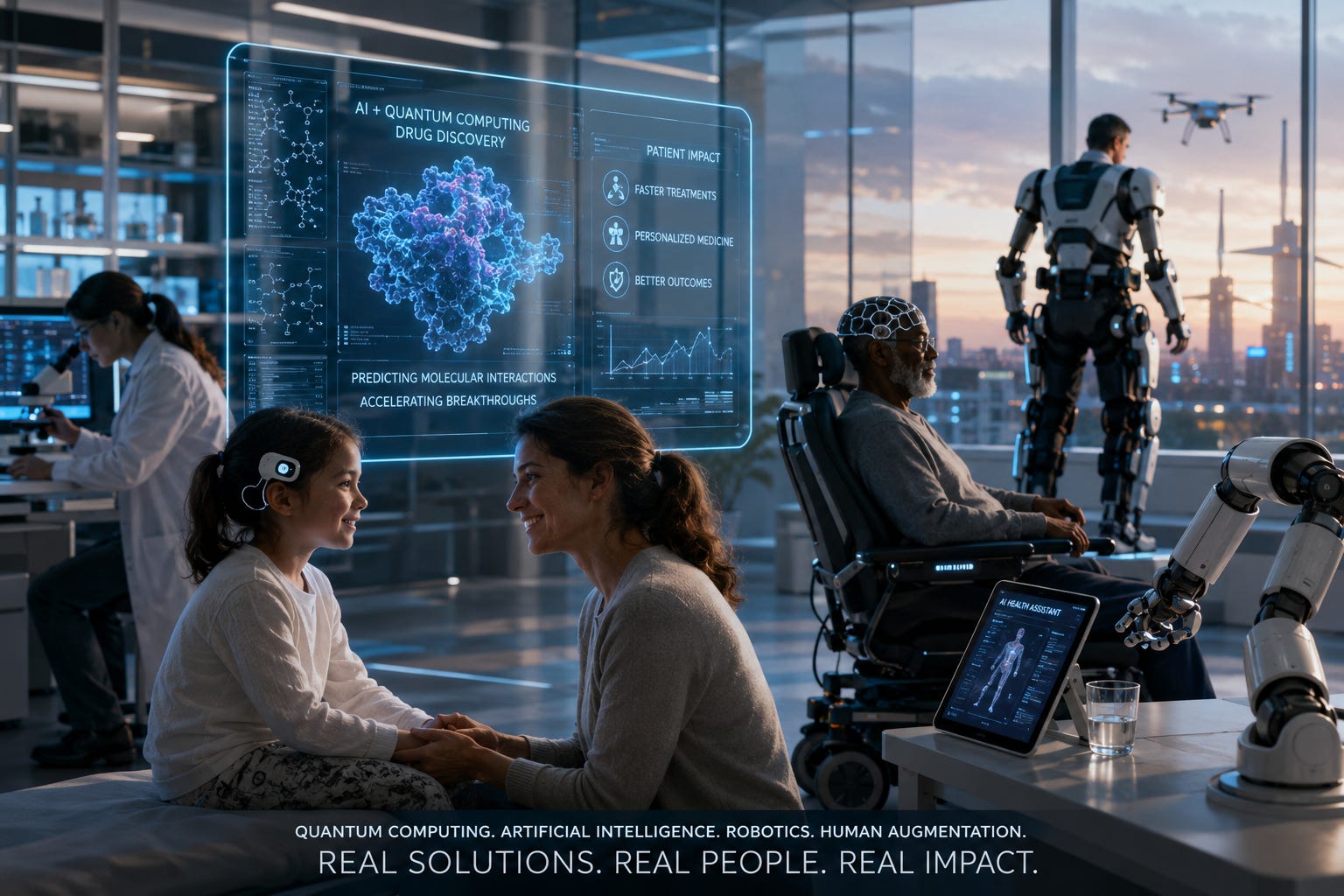
Imagine an AI system capable of modeling the interactions of millions of molecules simultaneously using quantum computing. Such a system could accelerate drug discovery, identify treatments for diseases previously considered incurable, and compress years of medical research into weeks or days.
Imagine climate models with unprecedented accuracy, capable of predicting environmental outcomes and guiding global responses with far greater precision than current systems allow.
Imagine advanced robotics powered by AI systems capable of processing vast amounts of information and learning from complex environments in ways that mirror or even exceed human adaptability.
Imagine neural interfaces that allow humans to interact with information directly through augmented cognition, assisted by AI and supported by computational capabilities that today seem almost unimaginable.
This is where the story becomes less about machines and more about people.
Throughout history, technology has expanded human capability. The wheel amplified movement. Printing amplified knowledge. Computers amplified calculation. The internet amplified communication.
The convergence of quantum computing, artificial intelligence, robotics, and human augmentation may amplify something even more profound: human understanding itself.
For the first time, we may be approaching tools capable of helping us explore questions that have remained beyond our reach for centuries. Questions involving consciousness, genetics, disease, energy production, materials science, environmental sustainability, and even the fundamental nature of reality could become accessible in ways previous generations could scarcely imagine.
Of course, every technological leap brings legitimate concerns. The same quantum systems that could accelerate scientific discovery could also threaten current encryption methods and cybersecurity frameworks. Advanced AI systems raise difficult questions about employment, ethics, misinformation, and human agency. Human augmentation technologies force society to confront questions of access, equity, privacy, and what it means to remain authentically human.
These challenges are real and should not be minimized.
History shows that technological progress is rarely defined solely by what we can build. It is ultimately defined by how wisely we choose to use what we build.
That is why this moment matters.
The recent developments surrounding quantum computing are not important because they suggest faster computers are coming. They matter because they indicate that multiple transformative technologies are beginning to mature simultaneously. The lines connecting quantum computing, artificial intelligence, robotics, biotechnology, and human augmentation are becoming increasingly visible.
When these fields begin reinforcing one another, the pace of innovation may accelerate beyond anything we have previously experienced.
For readers of The Augmented Life, this is perhaps the most important story of the week because it offers a glimpse beyond individual technologies and into a future shaped by their convergence.
The next era will not be defined by artificial intelligence alone. It will not be defined solely by quantum computing, robotics, or human augmentation.
It will be defined by what happens when all of them begin working together.
And if recent developments are any indication, that future may be arriving sooner than many of us expected.
Technology is changing the world. Read about it → The Augmented Life