


By J. H. Irwin
Author | Content Creator | Technology Strategist
The Future Is Arriving… Are You Ready?
For decades, the household robot lived mostly in imagination. It appeared in cartoons, science fiction films, futuristic appliance ads, and the occasional optimistic technology demo that promised more than it could deliver. We were told the future would bring mechanical helpers that cooked, cleaned, folded laundry, watched over the elderly, entertained children, and gave exhausted human beings a little of their time back.
That future is no longer entirely theoretical. It is not fully here, either. What we are witnessing now is something more complicated and more revealing: a race among some of the world’s largest technology companies and best-funded robotics startups to bring physical artificial intelligence into the home. The question is no longer whether machines will move beside us. The question is how soon, how capable, how affordable, and at what human cost.
The Home Robot Race Is Beginning, But Unevenly
The phrase “household robot” can mean several very different things. Some companies are building small mobile companions that follow us around the home, answer questions, project video, monitor routines, and connect to smart appliances. Others are developing humanoid machines with arms, hands, legs, vision systems, and AI models designed to perform human-like tasks in spaces originally built for human bodies.
That distinction matters. A rolling companion robot may help manage schedules, entertainment, wellness checks, or smart-home control. A humanoid robot, if it becomes reliable enough, could eventually do physical labor: carry laundry, unload a dishwasher, sort shelves, pick objects off the floor, assist with mobility, or support aging adults who want to remain independent at home.
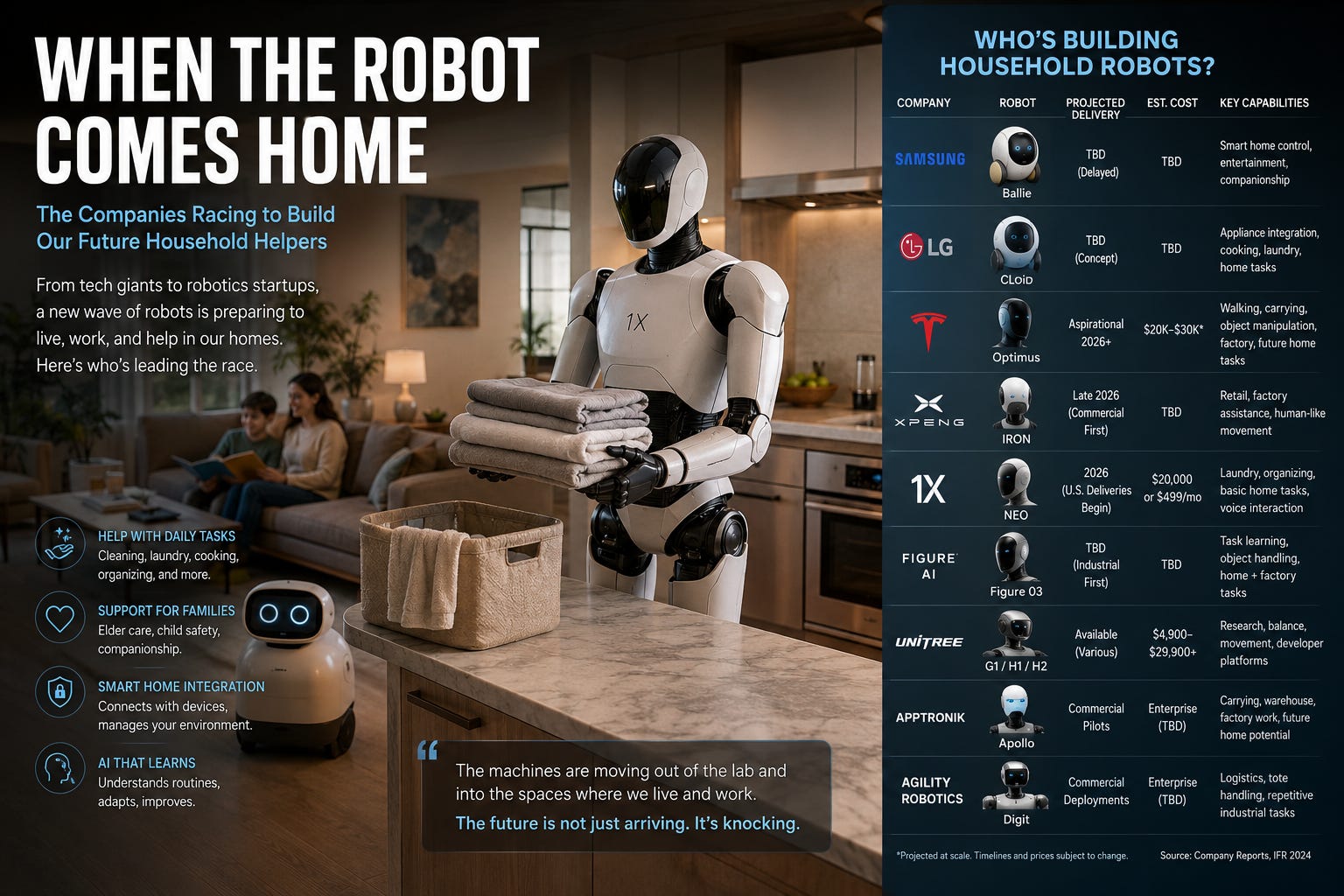
The companies currently circling this space fall into two broad categories. First are the consumer-electronics giants, including Samsung and LG, which already understand the home as a technology ecosystem. Second are humanoid robotics companies, including Tesla, Figure AI, 1X, Unitree, Apptronik, Agility Robotics, and XPeng, many of which are beginning in factories, warehouses, retail spaces, and industrial environments before attempting the far less predictable household market.
What These Robots May Actually Do First
The first wave of household robots will probably not be the all-purpose mechanical servants that science fiction promised. Early devices will be limited, expensive, and dependent on controlled environments. They may be able to fold some laundry but not all laundry. They may organize simple objects but struggle with clutter. They may understand a command but fail at the messy reality of socks under a bed, a dog toy on the floor, or a kitchen counter covered with last night’s dishes.
The most realistic early capabilities include smart-home control, basic object recognition, carrying lightweight items, reminders, entertainment, security check-ins, companionship, simple tidying, and limited household task assistance. More advanced humanoid models may eventually handle laundry, dishes, light cleaning, pantry organization, elder support, and physical help for people with mobility challenges.
The home, however, is one of the hardest environments for robotics. Factories are structured. Warehouses are mapped. Homes are emotional, unpredictable, crowded, private, and full of objects that were never designed for machines. That is why many companies are starting with industrial environments first. A robot that can repeat a task safely for ten hours in a factory is easier to commercialize than one that can walk into a family kitchen and understand what “clean up a little before guests arrive” actually means.
The Jobs Most Likely to Be Affected
The first employment effects will not come from robots taking over private homes. They will come from the same technologies being deployed in workplaces: warehouses, factories, fulfillment centers, retail back rooms, hospitals, hotels, elder-care facilities, and commercial cleaning operations.
The jobs most exposed are those built around repetitive physical tasks in predictable environments. That includes material handlers, warehouse pickers, stockroom workers, assembly-line support roles, inventory assistants, janitorial support, laundry services, hotel housekeeping, food preparation support, elder-care aides for nonmedical tasks, and some domestic-service work.
This does not mean every job disappears. It does mean many jobs may be redesigned around fewer people supervising more machines. The human worker may become the exception handler, the safety monitor, the repair liaison, the trainer, or the person assigned to tasks the robot still cannot perform. In better versions of this future, robotics reduces dangerous, exhausting, repetitive labor and gives human beings more dignified work. In worse versions, companies use robots primarily to reduce payroll, weaken labor power, and shift economic gains upward.
That is the moral question hiding beneath the engineering question. A robot that folds laundry is not only a convenience device. It is part of a larger economic story about who benefits when physical labor becomes programmable.
The Price of a Mechanical Helper
For now, a true household humanoid robot remains expensive. 1X’s NEO is the clearest consumer-facing example, with a listed early-access ownership price of $20,000 and a subscription option of $499 per month. Unitree’s lower-cost humanoids make robotics more accessible to developers, researchers, and enthusiasts, but those machines are not yet equivalent to a reliable home assistant. Samsung and LG may eventually enter the household market at more appliance-like price points, but their most ambitious home robots do not yet have firm pricing and delivery commitments.
The long-term target appears to be somewhere between a major appliance and a car. That is an enormous range, but it tells us something important. The first household robots will likely be luxury products, experimental subscriptions, or early-adopter machines. Over time, if mass production improves and AI control becomes more reliable, the price may fall into the range of a high-end computer, a home appliance bundle, or a monthly service plan.
The subscription model may matter as much as the purchase price. A household robot is not only hardware. It is software, cloud intelligence, data collection, updates, maintenance, and possibly remote human assistance. That means the true cost may include monthly fees, repair plans, replacement parts, privacy trade-offs, and limits on what the robot can do without a network connection.
The Privacy Problem No One Should Ignore
A household robot will not be like a dishwasher. It will see rooms, objects, routines, faces, voices, habits, schedules, and vulnerabilities. It may know when an elderly parent is alone, when a child comes home from school, what medications sit on the counter, how often people argue, and which doors are usually left unlocked.
That makes privacy one of the central issues of the household robotics era. A personal robot may become useful precisely because it observes so much. Yet the more it observes, the more sensitive it becomes. The future home robot will need strong local processing, clear consent controls, visible recording indicators, no-go zones, encrypted data, transparent remote-assistance policies, and the ability to function without turning the home into a corporate training environment.
The question should not be only, “Can this robot help me?” It should also be, “What does this robot know about me, who can access that knowledge, and what happens to it over time?”
The Human Question
Among the Machines is not simply about robotics. It is about the changing relationship between human beings and physical intelligence. AI is no longer confined to screens, speakers, and search boxes. It is beginning to move through the world with cameras, limbs, wheels, hands, and purpose.
That changes the emotional texture of technology. A chatbot can advise us. A robot can stand beside us. A digital assistant can answer a question. A physical assistant can enter the bedroom, the kitchen, the hospital room, or the workplace. That presence will feel different because bodies matter. Movement matters. Proximity matters.
The household robot may become a tool, a servant, a companion, a caregiver, a status symbol, an economic disruptor, or some uneasy combination of all of these. The technology will be sold as convenience, but the deeper story is about dependency, labor, privacy, aging, loneliness, and the value we place on human care.
Takeaway
The personal robot era is not arriving all at once. It is arriving unevenly, through prototypes, pilot programs, early-access devices, factory deployments, delayed launches, bold promises, and very real engineering breakthroughs. Some of these machines will fail. Some will be delayed. Some will become expensive curiosities. A few may become as ordinary, eventually, as a washing machine or a smartphone.
But the direction is clear. The machines are moving out of the lab and into the spaces where we live and work. The question is not whether robots will enter human life. They already have. The question is whether we will shape their arrival with wisdom, fairness, and human dignity, or whether we will simply open the door and let the market decide what kind of future walks in.
#JHIrwin #JHIrwinMultimedia #TheAugmentedLife #AmongTheMachines #Robotics #HumanoidRobots #HouseholdRobots #ArtificialIntelligence #AI #FutureOfWork #HumanExperience #TechnologyAndHumanity
Technology is changing the world. Read about it → The Augmented Life